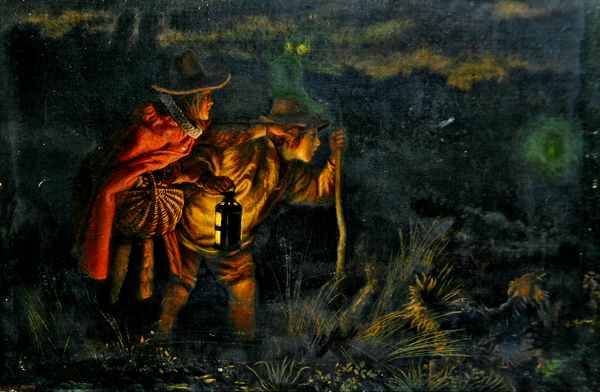

In the dead of night in the Fenlands of Eastern England, the ghostly Lantern Man appears to lure unsuspecting travellers to a watery grave…
The Fens are a naturally marshy region of England located in the East Midlands and East of England. Most of the fens were drained off centuries ago to support farmland developments, but once upon a time this area was notorious for its flooding and uninhabitable environment which made it extremely dangerous for travellers. While the area itself may look different these days, the small patches of marshland that are left carry an air of mystery and unease to them — a result of centuries of haunting legends of folklore.
Tales of the Lantern Man are remarkably similar to common marshland folklore, Will-o’-the-wisp. These are atmospheric ghost lights often witnessed by travellers at night in treacherous marshland or swampy areas of the country. Stories of ghost lights are not limited to one country in particular; many cultures have experienced versions of these over the many years — for example, the name “jack-o’-lantern” actually originates from the British form of the will-o’-wisp story. The differences between common will-o’wisp variations and the Lantern Man is that the latter includes a human apparition holding the ghostly light, and also appears to be much more hostile towards humans, actively malicious in their intent to lure people to their death.
Stories first collected by folklorist L.F. Newman state that the lights are believed to be evil spirits attempting to draw victims to their death in the reed beds, and the spirits are often attracted to the sound of whistling from passers-by. A commonly told method of evading the Lantern Men is to lay face down in the mud, whilst other stories suggest that if you are travelling in a pair or a group, to take turns whistling from opposing sides of the marshland, keeping the spirit stuck between them until the travellers reach safety.
An alleged survivor of the Lantern Man recounted an experience with the spirit which was collected in the Eastern Counties Collectanea. In this case, the Lantern Man is said to follow travellers home, lighting up their windows from the outside, and being angry that someone would cross the meadows at night with a lantern. The evil spirit is also described in this passage as being attracted to other lanterns, “‘The man knew what to do. He set the lantern down and ran away as if the devil kicked him. When he ventured to look round there was the Lantern Man kicking the lantern over and over again.’”
One of the most infamous stories and victims of the Lantern Man is Joseph Bexfield. While at a pub in Norfolk in 1809, wherryman Bexfield remembered he needed to retrieve a parcel for his wife from the wherry. Ignoring pleas from his friends to reconsider due to the pitch black mist and telling haunting tales of the Lantern Man, Bexfield headed out into the darkness. That was the last time he was seen alive.
Bexfield’s body would wash up on the banks of the River Yare after three days of thorough searches conducted in the marshland, much to the dismay of his grieving family. Locals still believe that the ghost of Joseph Bexfield can be seen drifting across the marshes on gloomy nights similar to the night he went missing, occasionally stopping to relight his lantern, before vanishing as quickly as he appeared.
The tales of the Lantern Man are commonly dismissed these days as sightings of combustible marsh gas. But who can really know? Would you want to take that risk on a dark, misty night when you’re travelling alone through the Fens of East Anglia? If you do find yourself in that unfortunate situation, just remember: don’t stop to light your torch and certainly don’t whistle.